“Your true pilot cares nothing about anything on earth but the river, and his pride in his occupation surpasses the pride of kings.”
— Mark Twain, Life on the Mississippi —
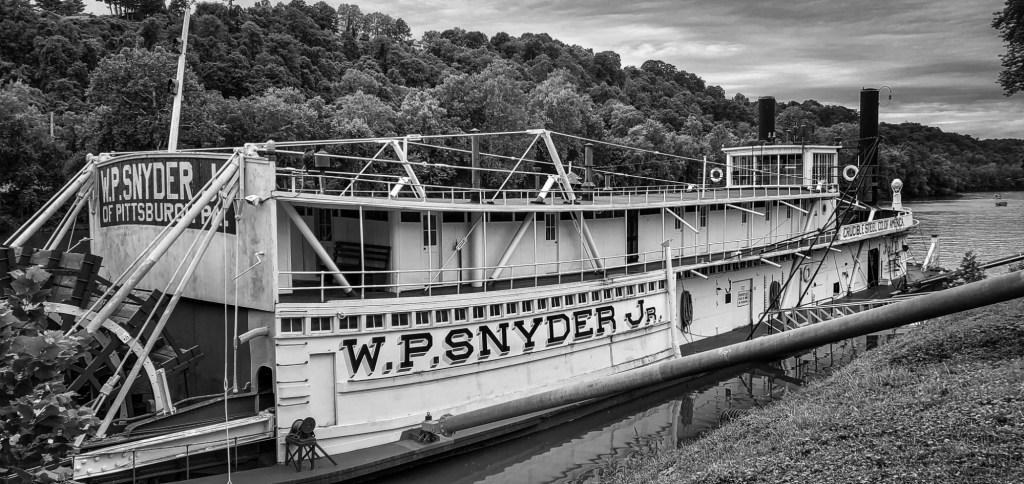
Parting the glistening currents of the Ohio River, her steam-driven sternwheel churns to the rhythm of water and machine. A world known only to her crew of 20, men working a six-hour watch, they labor to her melody.
Marietta, Ohio
August 13, 2022
The great river, known by the Iroquois as “O-Y-O,” and later named “Ohio,” greets her haul with a loving embrace. Its sparkling waters living up to the French name, La Belle Viviere, meaning beautiful river. A beauty that now tenderly flows softly with the steam-powered towboat — the term “tow” referring to the lashed assembly of barges it pushes forward on her journey along the Midwestern coastline.
When her haul first graced the waters in 1918, she was originally named the W.H. Clingerman; however, after being purchased by the Crucible Steel Company in 1945, she was renamed for their company chairman, W.P. Snyder Jr.
For more than three decades, her frothy wake echoed along the beautiful river towns. Laboring day and night, feeding the U.S. economy — a nation blessed with perfect geography, as its great rivers unite as one, forming the mighty Mississippi on a voyage to the sea — moving barges loaded with coal, iron ore, and steel.
As steam-powered engines gradually surrendered to diesel, her life story finally concluded in 1954. While many of her sister boats would be scrapped, fate intervened in 1955 when the W.P. Snyder Jr was donated as a museum piece.
 Everything Tells A Story...
Leave a comment